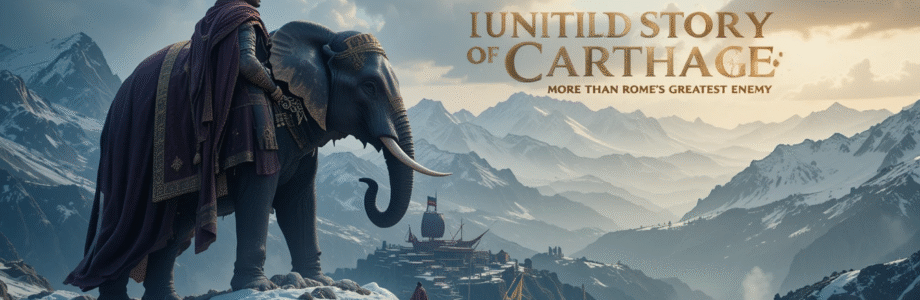
Picture this: a single man standing atop a frozen Alpine peak, wind whipping through his hair as he gazes down at the impossible terrain below. Behind him, 37 massive war elephants stamp their feet in the snow, their breath forming clouds in the frigid air. Before him stretches a treacherous path that no army has ever dared attempt. The man is Hannibal Barca, and this moment in 218 BC would change the course of history forever.
But this legendary Alpine crossing—one of the most audacious military feats in human history—is just one chapter in the epic tale of a civilization that has been unfairly reduced to a mere footnote as “Rome’s enemy.” Welcome to the real story of Carthage: a Mediterranean superpower whose innovations, culture, and achievements shaped the ancient world in ways that echo to this day.
For too long, we’ve seen Carthage through Roman eyes—as a rival to be destroyed, an enemy to be feared. But strip away centuries of Roman propaganda, and a far more fascinating story emerges: the rise and fall of a cosmopolitan empire that connected three continents, revolutionized agriculture, pioneered naval technology, and created the ancient world’s first truly multicultural society.
From Refugee Princess to Mediterranean Superpower
The story begins not with conquest, but with escape. According to legend, Carthage was founded around 814 BCE by Queen Dido (also known as Elissa), a Phoenician princess fleeing her murderous brother Pygmalion of Tyre. The tale of how she cleverly acquired land by cutting an ox hide into thin strips to encircle the hill of Byrsa has become legendary—though archaeological evidence confirms that Phoenician traders from Tyre founded the city in the late 9th or early 8th century BCE, matching the traditional founding date remarkably well.
What’s remarkable isn’t just that this story survived, but what it reveals about the Carthaginian character from the very beginning: resourcefulness, cunning, and an almost modern approach to negotiation and expansion. The fact that a powerful city was founded by a woman is too unusual to be mere invention, suggesting that even in its earliest myths, Carthage embraced a different kind of leadership.
But Carthage wasn’t content to remain a small trading post. By the end of the 7th century BC, Carthage was becoming one of the leading commercial centres of the West Mediterranean region. What gave Carthage its edge wasn’t just courage or luck—it was location. Positioned perfectly to control trade between the eastern and western Mediterranean, the city was built on a hilly, triangular peninsula backed by the Lake of Tunis, which provided abundant supplies of fish and a place for safe harbor.
Masters of the Seas
If there’s one thing that defined Carthaginian civilization, it was their mastery of the sea. While other ancient civilizations hugged the coastlines, the Carthaginians boldly ventured into the deep ocean, creating the world’s first truly global trading empire.
One of their greatest innovations was the quinquereme, a large and powerful warship with five rows of oars. The quinquereme was faster, more maneuverable, and better suited for naval battles than earlier ships. But their naval innovations went far beyond warships. Carthaginian merchants developed advanced navigation techniques, likely including celestial navigation to travel the Mediterranean accurately.
The scope of their maritime reach was staggering. Carthaginian coins have been found in the Azores and in Britain. The tin mines of Cornwall were the focus of trade with Britain, just as the gold, silver and copper of southern Spain were the important commodities of Cadiz. Around 500 BC, the Carthaginian admiral Hanno founded several colonies along the coast of what is now Morocco and proceeded to the gold river Senegal, and even reached Mount Cameroon.
Think about what this means: over 2,000 years before Columbus, Carthaginian sailors were already conducting regular trade with destinations thousands of miles from home, navigating by the stars and establishing a network of ports that connected Africa, Europe, and Spain in a web of commerce that wouldn’t be matched until the modern era.
The Agricultural Revolution Nobody Talks About
While most people know Carthage for its wars, the civilization’s greatest contribution to human progress might have been in agriculture. Far from being merely maritime traders, the Carthaginians revolutionized farming in ways that fed the ancient world.
The Carthaginians were the first people in history to use iron plows, a innovation that dramatically increased agricultural productivity. They practised highly advanced and productive agriculture, using iron ploughs, irrigation, crop rotation, threshing machines, hand-driven rotary mills, and horse mills, the latter two being invented by the Carthaginians in the sixth and fourth centuries BC, respectively.
The genius behind these innovations was recorded in one of history’s most influential agricultural texts. Mago, whom Greeks and Romans alike called “The Father of Farming,” wrote a 28-book treatise on agriculture. Mago’s long work incorporated local Berber and Punic traditional practices. Carthage being the granary of the central Mediterranean, knowledge of agricultural and veterinary practices was extensive.
After destroying Carthage, what did the Romans do with this agricultural knowledge? Mago’s agricultural treatise was so highly regarded that after the destruction of Carthage, the Romans translated it into Latin, ensuring that his knowledge would be preserved and passed on to future generations. In fact, after Rome’s destruction of Carthage in 146 BC, the Carthaginian libraries were given to the kings of Numidia—except for Mago’s agricultural works, which the Romans specifically preserved.
The Real Hannibal: More Than Just Elephant Stories
Now, back to that man on the mountain. Hannibal Barca wasn’t just a brilliant general—he was the product of a sophisticated military and political culture that had been refining the art of warfare for centuries.
Hannibal’s crossing of the Alps in 218 BC was one of the major events of the Second Punic War, and one of the most celebrated achievements of any military force in ancient warfare. Hannibal marched his army of 50,000 men, 5,000 horses and 37 elephants across the Alps, completing the journey in just 16 days, according to the Roman historian Titus Livius (Livy).
But the numbers tell only part of the story. The logistical challenge was immense: The task involved the mobilization of between 60,000 and 100,000 troops and the training of a war-elephant corps, all of which had to be provisioned along the way. His soldiers were dressed for the cold and snow, and may have equipped their sandals with the equivalent of modern crampons to give them more traction.
Recent archaeological evidence has even pinpointed his likely route. Biostratigraphic archaeological data has reinforced the case for Col de la Traversette; analysis of peat bogs near watercourses on both sides of the pass’s summit showed that the ground was heavily disturbed “by thousands, perhaps tens of thousands, of animals and humans” and that the soil bore traces of unique levels of Clostridia bacteria associated with the digestive tract of horses and mules. Radiocarbon dating secured dates of 2168 BP or c. 218 BC, the year of Hannibal’s march.
What’s most impressive isn’t just that Hannibal pulled off this impossible feat, but how he did it. The enemy were terrified by their strange appearance, and never dared approach the part of the column in which they were stationed, wrote Polybius about the war elephants. Hannibal used decoys, ambushes, and night-time maneuvers to outwit and overcome enemy forces, ensuring his army’s safe passage through the mountains.
Beyond Roman Propaganda: A Multicultural Empire
Perhaps the most revolutionary aspect of Carthaginian civilization was how genuinely multicultural it was. Recent DNA analysis has revealed something extraordinary about the Carthaginians that challenges everything we thought we knew about ancient empires.
The DNA analysis suggests that Carthage was the first biologically cosmopolitan civilization, essentially a cultural and religious “franchise” that the Phoenicians passed on to people with whom they had no genetic connection. This contrasts sharply with the contemporaneous colonization of the Mediterranean by the Greeks, who competed with the Carthaginians and didn’t mix much with local populations in the settlements they seeded.
Even more fascinating, this “radical mix” occurred pretty homogenously across the empire: it’s not that the Phoenicians in Sicily mixed with the local Sicilians and Greeks, while the ones in Tunisia intermarried with Africans. The genetic analysis shows that this population churn was constant and spread all over the empire.
Further evidence of this mobility is that within the roughly 200 genomes the researchers reconstructed, there were several cases of distant relatives who hailed from different parts of the empire, including two individuals who were second or third degree cousins, with one coming from Birgi in Sicily and the other from Kerkouane, in Tunisia.
In other words, Carthage operated more like a modern multinational corporation or the European Union than a traditional ancient empire. It was a civilization held together not by ethnicity or blood, but by shared culture, religion, and commercial interests—a remarkably modern concept that wouldn’t be seen again until our own era.
The Religion Nobody Understood
One of the most controversial aspects of Carthaginian society was their religious practices, particularly allegations of child sacrifice. For centuries, this has been used to paint them as barbaric. But modern archaeology tells a more nuanced story.
New archaeological discoveries are changing how we see Tophet sites. They suggest that stories of widespread child sacrifice might be too harsh or wrong. Recently, scholars have questioned whether the Carthaginians engaged in widespread child sacrifice, or if it was reserved for especially dire moments, or if the substantial archaeological evidence indicating such sacrifice has been misinterpreted, colored by the biased accounts of Carthage’s enemies, from whom we derive most of our information about the city.
The two main deities at Carthage were Baal Hammon and his consort, Tanit. Richard Miles writes that the word Baal means “Lord” or “Master,” and Hammon may come from a Phoenician word meaning “hot” or “burning being.” Miles notes that Baal Hammon is often depicted with a crescent moon, while Tanit, his consort, is shown with outstretched arms.
What’s important to understand is that Carthaginian religion was complex and sophisticated, with the Carthaginians retaining distinctive customs, including the sacrifice of infants to Baal Hammon and his consort Tanit, a practice that had long since been abandoned in Tyre and the other Semitic kingdoms of the Levant. Rather than barbarism, this might represent religious conservatism—maintaining ancient traditions that the homeland had discarded.
The Three Wars That Changed Everything
The Punic Wars weren’t just military conflicts—they were a clash between two fundamentally different visions of how to organize a Mediterranean empire. Rome represented military conquest and centralized control; Carthage embodied commercial networks and cultural assimilation.
The First Punic War started in 264 B.C. when the Mamertines, a group of former mercenaries based in Messina, Sicily, appealed to both Carthage and Rome for help against Syracuse. They ended up getting both requests answered. Richard Miles writes that Carthage sent a small force to Messina, which was then ejected by a larger Roman force.
The Second Punic War featured Hannibal’s legendary campaigns. After his Alpine crossing, he defeated the Romans in three battles, the Trebia (218 BC), Lake Trasimene (217 BC) and most decisively at Cannae (216 BC). The Battle of Cannae remains one of the most studied tactical masterpieces in military history, a double envelopment that destroyed a Roman army twice the size of Hannibal’s forces.
But the Third Punic War was different—it was, quite simply, genocide. When Carthage was finally starved into submission, in 146 BC, a population of 250,000 has been reduced to 50,000. These survivors were sold into slavery. The city burns for seventeen days, after which the ground is cleared and ploughed. Salt is scattered in the furrows, and a curse is pronounced to ensure that neither houses nor crops ever rise here again.
Actually, the detail about salt might be a modern-day myth has the Romans “salting the earth” to prevent the fields of Carthage being tilled again; however, there is no ancient evidence for this. But the systematic destruction was real enough—and it was so complete that when they later wished to found a new city on this strategic site, the curse proved something of a psychological obstacle for potential settlers.
Legacy of a Lost Civilization
What makes the Carthaginian story so compelling isn’t just what they achieved, but what was lost when they fell. The Carthaginians, who were Semites, were defined as a people of little value, and antisemitism significantly influenced not only the interpretation of physical evidence but the choice of what was kept for placement in museums or discarded during early archaeological work.
The Punic language, a dialect of Phoenician and a Semitic language related to Hebrew, would long outlast Carthage’s empire. It was still spoken in northern Africa as late as the fifth century AD, but died out soon thereafter, leaving only a few inscriptions and scattered quotations as witnesses.
But Carthage did eventually rise again. Julius Caesar proposed and planned the rebuilding of Carthage and, five years after his death, Carthage rose again. By the second century A.D., it was the largest North African city west of Egypt, featuring giant “Antonine baths,” that were “the largest public baths in the Roman Empire”.
Why Carthage Matters Today
The story of Carthage offers profound lessons for our own globalized world. Here was a civilization that thrived on diversity, innovation, and international commerce. They created sustainable urban systems with well-organized road systems that facilitated efficient movement of goods and people. Their advanced water management techniques, including aqueducts and reservoirs, ensured a stable water supply in their arid environment, supporting both agriculture and urban life.
Perhaps most importantly, Carthage shows us what we lose when we let military conflict eclipse cultural achievement. For too long, the Carthaginians have been remembered only as Rome’s enemies, their vast contributions to human civilization overshadowed by the propaganda of their conquerors.
But as modern archaeology continues to uncover the reality behind the myths, we’re discovering that Carthage was far more than just Rome’s rival. It was a beacon of innovation, a melting pot of cultures, and a testament to what humans can achieve when they embrace both diversity and excellence.
The next time you see a map showing ancient trade routes crisscrossing the Mediterranean, or read about agricultural innovations that fed ancient cities, or marvel at the logistics of moving large armies across impossible terrain, remember: you’re looking at the legacy of Carthage. Not just Rome’s greatest enemy, but one of humanity’s greatest civilizations—a reminder that history is always more complex, more fascinating, and more human than the stories told by the victors.